Introducing this section dedicated to the
statue of Persephone
I wish to thank Prof. Gaudio Incorpora, fond
expert of the historical and archaeological heritage
of our region, who since more than fifty years
still carries on his struggle of showing the true
origin of the statue of Persephone and avoiding that it's real
story may be forgotten.
I wish to thank him for the chance he gave me of
consulting his rich private archive, build patiently
during many years of researches, and for his
willingness to give me every explanation I needed
regarding the key points of this vicissitude,
allowing me to create this section and to learn facts
I was totally ignoring.
THE
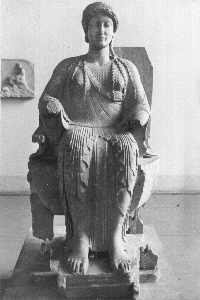
STATUE OF PERSEPHONE (Image source: Prof. G. Incorpora's private archive)
With the publishing on the internet of this which,
I'd like to point out is just a little part, a summary, of
the vicissitudes of statue of Persephone, I simply hope to let more
people know the forgotten (or, as you will better understand
reading this article, the ignored) story of one of the most
beautiful archaeological finds which Magna Graecia
handed down to us.
INTRODUCTION
If you have recently visited the Alt
Museum of Berlin (Staatliche Museen section of the German
capital city dedicated to the Greek-Roman finds) don't be
too surprised to read here that this magnificent statue of an
enthroned goddess, the Persephone (as it will be called from now
on) has Locrian origins, as was already theorized in 1917 by
various German scholars (such as the archaeologist and
numismatist Behrendt Pick,
one of Theodor Mommsen's favourite pupils), which found in
the statue a typical model of the Locrian colony.
The story of the Persephone is probably one of the many
vicissitudes which involved, between the end of the XIX
century a.D. and the beginning of the XX century a.D. a
large part of the Italian historic and artistic heritage,
harmed by too many stealing and looting. But in this story,
the theft of the Persephone, can be
found another element, maybe much more sad than the stealing
itself for who has the destiny of the ancient Locri at
heart, and that element is the attribution of other origins to this
wonderful statue; as a matter of fact every text of
archaeology or art-history which you could read and in which
the Persephone is represented you will surely see the name of
Taranto as her place of origin.
But, why Taranto? The story is long and complex and it's
even difficult to find a starting point to begin its
narration. It's better then to establish a certain fact: the
attribution of the statue to Taranto was made by
archaeologist Paola Zancani Montuoro in the beginning of the
1930's and from then on, regardless many facts and
researches which seem to contradict this attribution, the
statue was indicated as coming from Taranto.
THE PLACES IN WHICH
THE STORY DEVELOPED
Between the end of the XIX century
a.D. and the beginning of the XX century a.D. the
archaeological heritage of the ancient Locri Epizephyrii was
constantly harmed in part by the ignorance of common people
that found in the remains of the ancient city some easily
collectable material to reuse in the building of poor
houses, and in part (the bigger) by the smuggling of
artistic heritage done by the local squires which saw in it
a fast and easy way to profiteer, since buyers (private or
institutional) mostly foreigner abounded and the offer was
really wide: from statues to even entire columns.
Even the famous archaeologist
Paolo Orsi (to whom Locri will always be thankful for having
discovered and preserved as much as he could its great
historic and archaeological heritage) was informed of those
circumstances and in one of his letters he brought precise
charges particularly against the Scannapieco brothers which
he called "traders of foodstuffs and fancy goods and, at
the right time, even of antiquities" and remembered the
magnificent treasure formed by lances, rings, coins,
shields, amphorae and many other finds which they held in
their property "partly in the countryside and partly in Gerace", hoping for a
rapid institution of laws "provident
and strict for the tutelage of the monuments and against abusive excavations".
But such laws
still weren't
available; it's just the beginning of the XX century a.D.
and even the city of Locri (which, in those years, was
called Gerace Marina) was formed not long before and the
control of the territory by the authorities was little to
none.
After this dutiful introduction to make you
understand better the places in which the story developed
we'll now follow in detail the evolution of the vicissitude
which involved the Persephone.
THE STORY OF THE THEFT
The 16th December 1915 the statue was exposed at the Royal
Museum of Berlin; the German experts, with the already cited
Pick, immediately theorized a Locrian origin. But how did it get to Germany?
Until the 1921 all the story was
enveloped in mystery and silence; but in that year prof. V.
Casagrandi published a book in which he reported in detail
the theft of the statue and invited the cultural forces of
the place to claim back the sculpture. With the publishing
of such book the story become much clear and outlined. It
began at the beginning of 1905 (date discovered, thanks to
an eye-witness, only in 1966 and so completely ignored by
Casagrandi who thought that the statue was discovered in
1911 and immediately sold - This particular, of lesser
interest at first sight, is instead of extremely high
importance as we'll see later on, and probably it has been
decisive for the troubled story of the Persephone).
In that year, during some works in
a vineyard owned by the Scannapieco family, the statue was
discovered. Vincenzo Scannapieco, the owner of the land, hid
the sculpture in an oil mill waiting for the right time to
sell it to the best buyer, and there the statue was left
until 1911, year in which a German buyer sealed the
deal.
The precious find was firstly
carried to Gioiosa Marina where, thanks to a coast with deep
waters, was embarked on a boat with Taranto as destination. There the statue was hid next to
the arsenal waiting to be embarked for Germany.
But events didn't go as it was
planned since the sculpture was discovered by some diggers
which didn't imagine to have by the hands a real treasure and
sold it for a crust of bread to the Marquis F. De Maldè who
moved it to Eboli where it was studied by the famous
Palermitan antiquarian Virzì.
Some years later the statue went
through the customs as a "baroque garden statue" and
ended up in the hands of the Bavarian antiquarian
Hirsh, who exposed it in Paris in 1914.
That was the year in which began
the First World War; therefore the French authorities
confiscated the statue since it was property of an
individual of German nationality, and so an enemy.
After that the Hirsh, as a last
desperate attempt to avoid losing the statue, tried to make
his friend Virzì, the already cited Palermitan antiquarian,
to intercede for him with the French authorities. Virzì, who
was also an Italian Consul in a Southern American Republic,
thanks to his office and to the fact that in a troubled age
the French authorities wanted to have the best possible
relationships with Italy, was able to retrieve the
statue stating that he was the real owner.
But obviously the sculpture never
went back to Italy; from France it was moved to Switzerland
and there the Hirsh, who took again the ownership of the
statue, offered it to the German authorities for one million
marks (a really big amount of money, it's the 1915). Even if
the Hirsh was asking a lot of money, the Germans immediately
collected the requested amount and also the Emperor
participated to the collect giving about an half million of
marks for the sculpture.
Finally the story of the theft
reaches an end; the statue (which, as it is pointed out in
Prof. Casagrandi's book, was recorded as "Persephone in throne from Locri”")
found its final place at the Royal Museum of Berlin and for
Italy, for Magna Graecia there was nothing left if not only
controversies.
THE CONTROVERSIES
And there were a lot of
controversies, even violent ones; mostly due to the book of
Prof. Casagrandi, who on one hand brought a decisive
contribution to let the Italian cultural world know the
story of the theft of a so precious treasure, and on the
other hand insinuated absurd suspicions regarding the fact
that at the time of the discovery and of the theft of the
sculpture the director of the archaeological excavations in the area of
Locri Epizephyrii was Paolo Orsi, who according to
Casagrandi had to know of the statue and so (always
according to Casagrandi) had to be in some way an accessory
in the theft.
Obviously these suspicions were
false and groundless and Orsi didn't deserve them for all
the good he did for this region. Suspicions which probably
were made (sadly as it has always been) out of envy
and with the will to discredit the Orsi to remove him from
his Office in favour of someone else.
The only effect of these charges
was terribly harmful for the story of the Persephone and its
aftermaths are still visible nowadays: the opening of a
clash between the scholars which were for or against Orsi.
This clash led to false and groundless assertions such as
the one of Prof. Galli who, attempting to defend his friend
Paolo Orsi, tried even to assert that the statue was a
false. In the controversy took place also Prof. Paola
Zancani Montuoro, at that time in charge of the Tarantin
Archaeological Office, who after a long chain of polemical
letters, also against the already cited prof. Galli, was
able to make his theory prevails above all the others;
theory which stated that the statue was from Taranto.
And that's why those controversies were terribly harmful;
controversies which hadn't the need to exist if Casagrandi had known that the statue, as
already has been said, was discovered in 1905 and not in
1911. In 1905, as a matter of fact, Orsi wasn't in
charge of the Office for the area of Locri Epizephyrii,
Office which he will occupy only from 1908;
hence, if still there was the need, he couldn't have been
the object of the charges moved against him regarding the
theft of the sculpture.
Obviously, no one can say this for
sure, but almost certainly if Casagrandi hadn't call
into question Paolo Orsi starting a controversy between
scholars, especially between those that were ready to lie
(even asserting that the Persephone was a false) to protect
the famous archaeologist from Rovereto, probably nowadays the
Persephone would still be an exile, but everyone would look
at her as to an exile daughter of Locri.
THE TESTIMONY
BY GIOVANNI GIOVINAZZO
In 1966 a new element, absolutely extraordinary for
its importance, enriched the story with a new chapter.
Thanks to the patient research work made by Prof. Gaudio
Incorpora, fond expert of the historical and archaeological heritage of our region,
about the troubled vicissitude of the Persephone, was found
an eye-witness of the facts happened sixty years before.
He was an old farm-worker who worked for Vincenzo
Scannapieco and witnessed the discovery and the
theft of the statue. He decided to speak of what he
knew only after his nephew, a priest, freed him from
a silence oath that he made sixty years before to
his old master.
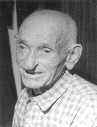
The name of the old farm-worker was Giovanni Giovinazzo
and in 1966 he was almost in his eighties, but
his memories were so clear that it seemed that he
had lived them just few days before, and he was also
able to point with precision the places where, at
the beginning of the century, the facts happened.
GIOVANNI GIOVINAZZO (Image source: Prof. G. Incorpora's private archive)
The sensation which was caused by the narration of the facts
was so great that other than the national press even
the television with its national news was interested about
the story. Here is a small summary of the words that
the reporter, Mr. Paolo Cavallina, used in the commentary of his
report on Giovanni Giovinazzo made for the news program of
the 25th June 1966 on the Italian State Television (RAI):
"Giovanni Giovinazzo from Locri
is a man of his word. Even too much. He swore to keep a
secret and kept his oath for more than sixty-one years. If
it wasn't for don Giuseppe, his nephew and parish priest of
Moschetta which freed him from that oath, from his mouth the
name of Persephone wouldn't have ever been pronounced with great
harm for the archaeology".
The report goes on with a summary of the story of the theft
followed by some words of Giovinazzo himself while he guides
the reporter and other journalists on the place where sixty
years before was made the discovery: "Vincenzo Scannapieco
(It's the Giovinazzo that is speaking) was a good man; when
he died he left all his properties to the City, meaning that
he was repentant for having sold Persephone. (And, let us add,
many more archaeological finds, thinking again at the already
cited words of Paolo Orsi's letters). Yes, Persephone was
down here - where the old man beats with the stick - and
this was the winch used to take it up and it took a lot of
patience and a lot of fatigue! And these were the chains
needed to put it on the wagon". Then the narration of the
reporter starts again: "It's a convincing speech. Now the
archaeologists could establish again the truth and give again
to Persephone, Goddess of the good and of the evil, her true
homeland which probably was Locri and not Taranto. The old man
which kept the silence for sixty-one years asks: - What difference
it makes?"
Briefly summarizing the testimony of the old farm-worker,
which caused a lot of sensation on the press, on the radio
and on the television, must be underlined the essential
details: the clear indication of the year in which the
Persephone was discovered, the 1905 (with the information
regarding the way in which it has been brought to
light and a couple of names of the farm-workers which were
involved in the discovery); the hiding of the statue until
the 1911 in an oil mill in Quote district and, finally, the
transfer from its hiding-place, that same year, to be
carried with a wagon to Gioiosa Marina where it would have
been embarked on a boat for Taranto.
Then this is the testimony and its validity cannot be
questioned by anyone since it was made official by a legal
act, an inquiry (whose acts nowadays can be found at the
archive of the Court of Locri) done in 1966 by the Republic
Chief Attorney of the Court of Locri of that time, Mr.
Domenico Palermo, who took the testimonies of all the people
involved in that vicissitude.
During that time it was believed that an happy end of the
story was close but, after the first time of euphoria, the
vicissitude felt again in the silence and in the
indifference of the people and, the worst of all things, of
the academic world.
THE ATTEMPTS TO BRING
THE STATUE BACK TO ITALY
Anyway, in 1966, thanks to a visit in Locri by the then
President of the Italian Republic Mr. Giuseppe Saragat and to
the recovered interest of the Locrian people for the history
of their past and for the fate of the Persephone (caused by
the extraordinary testimony by Giovanni Giovinazzo), the
Locrian cultural world understood that it was the right time
to awake from a too long time of inactivity and charged the
City administrators with the request to involve the National
Government in an attempt of obtaining by Germany the return
of the statue, even asking a direct interest in the
vicissitude by the Republic President.
The request was accepted and the Public Instruction Ministry
(which, at that time, was the one deputed to the Cultural
Heritage) started immediately an inquiry which led to a
really fast answer sent to the Locrian administrators.
In that answer, dated 11th July 1966, the Ministry said
that, analyzed the situation, the vicissitude of the
Persephone had to be counted amongst "the much greater
problem of the artistic heritage thefts happened during
various ages and for various reasons between many
countries". Obviously it was a bureaucratic answer which
meant "we are sorry, we know the situation, but we can do
nothing about that"; it all came to nothing then, but that
answer was however important because it was referred, as the
subject of the matter, to the "return of the Persephone,
stolen in Locri"; for the first time, then, even the
Ministry underlined the Locrian origin of the statue.
This fact must be added to
another one; the Ministry inquiry went on and there was
another request, dated 9th September 1966, this time made
by the General Office for Antiquities of Rome to the
Superintendence of Taranto to view the acts in their
possession related to the
Persephone. The 16th of September the
Superintendence answered sending to Rome a detailed report
in which it was said that many excavation tests had been made in the place "where the statue was found without,
anyway, reaching any positive result". So, there were no
archaeological evidences to prove that the site where the
Persephone was found was also her original place; on the
contrary it was strengthened the theory which wants Taranto
just as a transit location but not the place of origin of
the statue.
With this last request and the following answer between the
General Office for the Antiquities of Rome and the
Superintendence of Taranto, ends another chapter of this
story, a chapter in which the Persephone was again at
the centre of the attention and which started with the
attempt to bring the statue back to Italy and that ended up
with a clear and undeniable institutional position which saw
Locri as the place of origin of the statue.
The silence felt again on the vicissitude even if a couple
of other attempts were institutionally made to bring the
Persephone back to
Italy, but they had no luck.
In the following years some parliamentary
initiatives have been made, even recently, trying to throw light on this
vicissitude. As a matter of fact from 1984 to 2004
in the archives of the Chamber of Deputies can be found at
least six questions in Parliament made by Calabrian Deputies
and addressed to the person in charge of the Ministry
deputed for the Cultural Heritage. Of all of them only one,
dated back to 1997 (N. 4/07682 of the 19th February
1997, session n. 154 of the XIII Legislature) and made by
Hon. Fortunato Aloi, received an answer and it was a very
disappointing answer given by the then Minister for Cultural
Heritage Hon. Walter Veltroni. In fact he, just to give an
idea of the answer, was able to claim that "it's not
possible to start an action to obtain the return of the
statue" to avoid the compromising of "the
already undergoing collaboration" with the German
authorities "for the return to Italy of goods for which
our requests have much better foundation"; we'd like to
ask to the former Minister a question about which
had to be those much better foundations since, doubtless,
the sculpture comes from Magna Graecia and was stolen and
smuggled (and so it wasn't legally sold) to Germany in the
beginning of the XX century a.D.
Maybe the former Minister with his "much better foundation"
answer wanted us to understand that the Persephone didn't
have a lot of attention from the Italian academic world and
that, then, no one would have cared too much if the statue
would have remained in Berlin.
And, sadly, the Persephone "zu Lokroi" never had this kind of attention from
the academic world. As a matter of fact bringing on the
theory of the Locrian origin of the Persephone, backed by
proofs, historical analysis, temples and cults,
archaeological finds and more then convincing testimonies,
would mean contradicting prof. Zancani Montuoro, one of the
mythical figures of the Italian archaeology, risking this
way to stain his own name in the academic world; than it's
better to let it be without trying to venture in difficult
and hard researches, neither for reaching an historical
truth finally sure.
But this is of less to none interest for us; it's not the
matter of this site to establish truths or lies, to give
merits or faults. The objective of this section dedicated to
the Persephone is to let the people know, as it was said in
the beginning, the forgotten story (or, better, the ignored
story) of the theft of the Persephone from the place were she
laid for more than two thousand years to her landing place
(by this time, we fear, final) to the Alt Museum in
Berlin.



 PREVIOUS FIND
 FINDS INDEX
 NEXT FIND