|
|
These sculptures are amongst Magna Graecia's most
remarkable ones and they were unearthed by archaeologist
Paolo Orsi during the 1890-1891 excavation campaign.
The Dioscuri were a part of the sculptural
decoration of the west pediment of the Temple of Contrada
Marasà, but it's still unclear whether they were placed as
the acroterion decoration or if they were included inside
the tympanum.
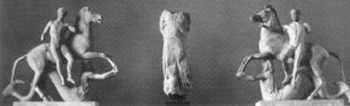
SCULPTURAL GROUP OF THE DIOSCURI
(Image source: G. Incorpora -
Locri Antica e Gerace,
Ponte Nuovo Editrice, Bologna 1980 - II Edizione - pag. 93)
|
The
sculptures, which date back to the end of the V century b.C.
or to the beginning of the IV century b.C., are made in Parian marble. The sculpture on the right is the better
preserved (even if the head was found by archaeologist
Alfonso De Franciscis only in 1956) whereas the one on
the left keeps only few original pieces, integrated by a
restoration in white plaster made during the first years of the XX
century.
Another
sculpture, discovered few years before the Dioscuri, has
been placed side by side with the two knights. This
sculpture represents a nereid (a sea nymph which could
refers to the two tritons carrying the horses of the
Dioscuri) or a Nike (supposing that the whole sculptural
group was made to celebrate the Locrian victory in the
Battle of the Sagra, during which, according to the legend,
the Dioscuri themselves fought by Locrian side, leading
Locri to the final victory).
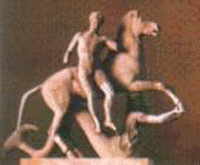
DIOSCUROS
(Image source: G. Incorpora -
Locri Antica e Gerace,
Ponte Nuovo Editrice, Bologna 1980 - II Edizione - pag. 93)
|
Actually the
scholars are not so sure about the belonging of
this last sculpture to the decorative group of the Temple;
anyway, at the National Museum of Reggio Calabria, it is
exhibited between the two Dioscuri, thus forming a unique group.
|
|
MYTHOLOGY |
|
The Dioscuri are the twins Castor and Pollux, sons
of Zeus and Leda and brothers of Helen of Troy and
of Clytemnestra. Leda, who was the wife of Tyndareus
king of Sparta, spent the same night with his
husband and with Zeus. From this unions born two
couples of twins: Pollux and Helen of Troy from Zeus
(therefore immortal) and Castor and Clytemnestra
from Tyndareus (therefore mortal).
Another version of the myth tells, instead, that Leda
was surprised by Zeus (transformed into a swan) and
from that union she procreated two giant eggs from
which the two couples of twins were born.
Castor was a warrior, a skilled horse trainer, while
Pollux was an expert boxer. Together they made many
feats, such as the rescue of their sister
Helen of Troy, kidnapped by Theseus and held
prisoner in the Afidna fortress; or such as their
presence during the hunt to the wild boar of
Calidonius or their joining of the Argonauts'
expedition.
Always together, they kidnapped the priestess
Hilaeira and Phoebe with which they felt in love;
but the two women were already betrothed to the cousins Idas
and Lynceus, who fought against the Dioscuri for the
love of the two women. During the fight Castor was
killed by Idas, while Pollux killed Lynceus. The
fight was stopped by Zeus, who killed Idas and
carried Pollux to the Olympus. But Pollux refused
his immortality if it couldn't be shared with his
brother. Then Zeus granted that they could live one
day each alternatively between Olympus and Hades.
In the night sky Castor and Pollux are the two
brightest stars of the Gemini (the twins)
constellation. |
|
|



 PREVIOUS FIND
 FINDS INDEX
 NEXT FIND