|
In the beginning of the VI
century b.C. all the principal cities of Magna Graecia's
Ionian coast had reached an high economic, cultural and
demographical development. This is why the interest of every
city was focused on the increasing of the territory under
their own control.
But at that
time every portion of territory was under the influence of one
or another city; trying to expand the control of a single
city over other territories meant a declaration of war
against another polis.
That's why
the VI century b.C. was the stage of great clashes between
Magna Graecia's colonies; battles which established the new
balances and the new power relationships and that were:
the battle of the Sagra River (the clash between Locri Epizephyrii
and Kroton), the destruction of Siris
(accomplished by Sybaris and Metapontum), and the clash between Kroton and Sybaris (which ended with the destruction of the latter).
As it
happens for other events of this age, as well for these
military clashes we don't have the exact dates; regarding
the destruction of Sybaris the scholars, following the
historical tradition, believe that it was around the 510
b.C., while it's much difficult to point out a certain date
for the other two great battles (which, probably, have to be
placed around the 580-560 b.C., with the destruction of
Siris preceding the battle of the Sagra).
THE BATTLE OF THE SAGRA RIVER
As we have already seen, the battle of
the Sagra river (a still unidentified water stream; probably
one of the modern Torbido, Amusa or Allaro) has to be
counted amongst those territorial expansion clashes and it
was fought by the armies of Locri Epizephyrii and Kroton.
It's the first half of the VI century b.C. and the two cities,
Locri and Kroton, had reached a very high economic and
social development; both of them had expanded their
territory: Locri over the Tyrrhenian coast and Kroton to the
south, taking the control of the city of Kaulon (name that
could make you think about the modern Caulonia, located 25
km away to the north from the ancient Locri Epizephyrii, but
actually its ruins have been brought to light near the
modern town of Monasterace, which is 35 km away to the north
from the site of the ancient Locri), last outpost of Kroton
before Locri Epizephyrii's territory.
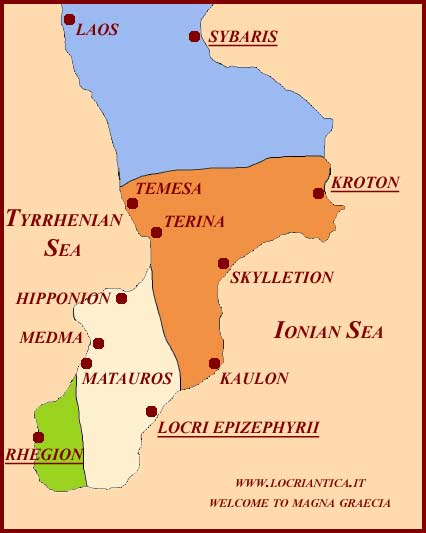
THE INFLUENCE AREAS OF THE FOUR MAJOR POLIS IN CALABRIA DURING THE VI CENTURY B.C.
So, during
that age, there was a standstill situation since the two
cities hadn't any chance of further expansion: Locri, once
accomplished the expansion over the Tyrrhenian coast, had to
stop since its expansion routes were blocked southwards by
Rhegion and to the north by Kroton; a similar
condition involved Kroton, which was blocked to the north by
Sybaris and to the south couldn't go past Kaulon.
With a
situation like this and since both the two cities had a strong will of
expansion war was just a matter of time.
That said,
now it
has to be taken into account another fact: the strength of
the two cities. As a matter of fact, even if both of them
had a prosperous economic situation, from a
demographical point of view Kroton was a metropolis compared
to Locri. In fact the population of Locri Epizephyrii,
even at the time of his largest expansion, didn't count more
than 40.000 people and, also with the help of the city's
sub-colonies (and, probably, of Rhegion, at least during
this age), its army was formed by only 10-15.000 men. On
the contrary Kroton, counting on a larger population (from
the city itself and from the allied towns) formed an army of
more than 120.000 men (probably these numbers, handed down
by the tradition, are excessive compared to the ones that
really were involved in the event that took place at the
Sagra river, but that doubtless witness the unbalanced strengths
which were about to fight, with Kroton starting the battle
with a really large numeric advantage).
If it is
also considered that, during that age, the military strength of Sybaris
was at least equal to the one of Kroton, it seems obvious
that Kroton decided to look at Locri, willing to conquest it
and certain, thanks to the large military superiority, of doing
so in an extremely easy way, planning to expand its own
territory southwards, next to Rhegion's borders.
But the
people of Kroton didn't think about the strength and the
surviving instinct of a population, the Locrian one, which
was well aware that a surrender or a defeat would have
meant his own end and that, therefore, was ready for all to
reject such eventuality.
The Locrians, therefore,
not panicked and planned the defense as best as possible. They decided
not to wait for the enemy inside the city, within the walls; they,
rightly, believed that they wouldn't be able to keep at bay the
overwhelming superiority of Krotonians that, sooner or later,
could have made a breach in the walls.
Then it was decided for
an open field battle, and there the Locrian commanders fulfilled their
masterpiece; they chose, in fact, a place along the Sagra river wedged
between the sea on one side and the last slopes of the mountains on the
other, a place where it was impossible to deploy a large number of
soldiers.
In that place took sides
the Locrian army waiting for the Krotonian enemy. The army of Kroton
reached that place and, as expected by the Locrian commanders, could not
deploy as desired without being able to express all his power and
superiority. At this stage it was the Locrian army that decided to launch the
attack with the anger and the fury of those who know they have nothing
left to lose, and soon managed to make a breach in the central part of
the enemy deployment, wounding the Krotonian commander in
chief, Leonimus, and throwing into disarray the entire enemy
army (of which one must also consider the psychological
situation of those who, sure of winning, are now facing a disastrous defeat) that, now broken, was caught behind by
the Locrian cavalry.
It was a victory so
extraordinary and unexpected that many were the accounts and the legends
that flourished about it; among them should be mentioned the Legend of
the Dioscuri. In fact the
tradition tells that during the battle, amongst thousands of
contenders, two young men rose, armed unlike the others, who gave no
respite to the Krotonian soldiers and that, at the end of the battle,
disappeared into thin air. These young men were immediately identified
as the Dioscuri, Castor and
Pollux, the twin sons of Zeus and Leda, wife of Tyndareus, king of
Sparta and brothers of Helen of Troy and Clytemnestra.
CONSEQUENCES
The defeat of Kroton resulted,
obviously, in serious consequences in terms of control over
the territory. Locri Epizephyrii, in fact, expanded his
control much further north than it had ever done,
incorporating under its influence Kaulon and, probably,
Skylletion (Scylletium) on the Ionian coast and Terina and
(maybe) Temesa on the Tyrrhenian coast, thus taking the control of the area between the gulfs of
Squillace and S. Euphemia. To the south, however, at least at this time,
Locri Epizephyrii had close relationships of good neighborliness with
Rhegion (saved, thanks to the Locrian victory, from a later Krotonian
advance).
So the situation was
prosperous for Locri Epizephyrii that, in fact, experienced in the years
between the mid-sixth century and its end (Kroton defeated Sybaris in
510 b.C. regaining the ancient strength) a period of great
prosperity.
|



 PREVIOUS CHAPTER
 HISTORY INDEX
 NEXT CHAPTER